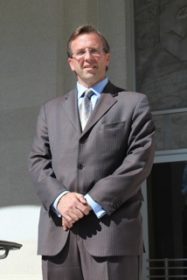
McGeorge Adjunct Professor Chris Micheli outside the California State Capitol

https://soundcloud.com/capimpactca/introduction-to-legislative-drafting

What exactly is legislative drafting, sometimes also called bill drafting? To start, legislative drafting is defined more broadly to include primary legislation and secondary legislation.  Primary legislation is what immediately comes to mind when you think of legislation – bills, resolutions, and constitutional amendments that are debated and voted on by the legislative branch.

McGeorge Adjunct Professor Chris Micheli outside the California State Capitol

https://soundcloud.com/capimpactca/convening-the-new-legislative-session

The next legislative session starts on Monday, December 7, at 12 noon. Despite the fact that it is technically starting in 2020, it will be designated the 2021/2022 Legislative Session. As you might imagine, there are numerous provisions around convening the new session laid out in the Constitution, state law, and Assembly Rules.

The

McGeorge Adjunct Professor Chris Micheli outside the California State CapitolToday’s podcast is a little bit different. Not only does today’s post feature video, rather than audio, it also features two of my colleagues – Robert Moutrie (Policy Advocate at the California Chamber of Commerce) and Laura Curtis (Legislative Advocate). I discuss with them their advice for lobbying committee staff and committee members in the

McGeorge Adjunct Professor Chris Micheli outside the California State Capitol

All measures in the California Legislature are required to prominently display the Legislative Counsel’s Digest on the front page of the bill. So, what is this required section of every measure?

According to the Legislative Counsel’s glossary of terms, the Digest is prepared by the Legislative Counsel and it summarizes the effect of a proposed

McGeorge Adjunct Professor Chris Micheli outside the California State Capitol

https://soundcloud.com/capimpactca/the-reenactment-rule

What is California’s reenactment rule? The state’s constitution, in Article IV, Section 9, states, “ A section of a statute may not be amended unless the section is reenacted as amended.” But what exactly does that mean?

The courts have determined that the purpose of the reenactment rule is to avoid enacting statutes in

McGeorge Adjunct Professor Chris Micheli outside the California State Capitol

https://soundcloud.com/capimpactca/why-a-bill-may-be-declared-unconstitutional

On occasion, California statutes can be challenged in either state or federal court with the argument that the statute violates the California or United States Constitutions. So, on what bases can a statute be declared unconstitutional?

One basis is vagueness. Essentially, the standard here is whether or not the statute is written with a

McGeorge Adjunct Professor Chris Micheli outside the California State Capitol

https://soundcloud.com/capimpactca/californias-revolving-door-prohibitions

The so-called revolving door in politics – elected officials leaving public service to work in the private sector lobbying their former colleagues – is no secret. In California, we have a number of rules and laws to slow the so-called revolving door. The rules can be found in Article IV, Section 5(e) of California’s

Every election year, McGeorge Associate Dean Mary-Beth Moylan teaches the California Initiative Seminar. In it, students analyze every Proposition on the California ballot. That work culminates in the publishing of the California Initiative Review, the California Initiative Review – Initiatives At-A-Glance, and the California Initiative Forum. All of these resources are made available

McGeorge Adjunct Professor Chris Micheli outside the California State Capitol

https://soundcloud.com/capimpactca/are-legislative-findings-and-declarations-necessaary

Sometimes, when reviewing California bills, you come across legislative findings and declarations. What are these, and are they necessary? There are essentially two schools of thought for the second question, but let’s first address what these are.

Sometimes bills will contain the equivalent of what we call a preamble, or a declaration of purpose.