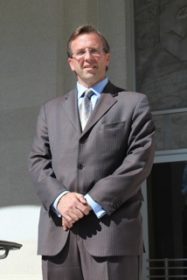
McGeorge Adjunct Professor Chris Micheli

https://soundcloud.com/capimpactca/tracking-and-analyzing-bills-and-regulations

An important role for any lobbyist is to track and analyze legislation and regulations. Tracking and monitoring doesn’t just mean new bills and regulations. It also means amendments to those bills and regulations, budget actions, gubernatorial actions, and monitoring executive branch activities.

On the regulatory side, there are over 200 rulemaking bodies in the state of California ‑‑ different administrative agencies, departments, boards, and commissions. According to our Office of Administrative Law here in California, those administrative agencies promulgate about 600 regulations each calendar year. As well, those agencies issue interpretations, executive orders, and formal guidance throughout the calendar year.

In terms of legislation, our legislature introduces on average 2,500 bills, with about 1,000 of them getting to the governor’s desk, and he signs between 85‑ and 90‑percent of those measures. There’s also, according to our Legislative Counsel Office, between 8,000 and 10,000 amendments to those 2,500 bills each year, so it’s quite a number of bills and amendments to track and analyze.

That’s a lot to keep track of, and there are public and private services to help advocates do that. One free bill information service is provided by the California Legislative Counsel, and it allows users to search for and track bills, as well review the full text of bills, resolutions, and constitutional amendments. It also lets users see a bill’s history, status, votes, analyses, and veto messages.

On the private/commercial side for tracking legislation there are a couple of options. One is LegiScan, which monitors bills in Congress and in all fifty state legislatures. Another paid option is CapitolTrack, which focuses on only California and takes data from the Legislative Counsel and other sources to allow users to customize bill tracking and reporting for clients or produce lists of bills by committee in each house.

On the regulatory side, the best source is California’s Office of Administrative Law. There are a number of methods for lobbyists to track regulatory actions by one or more administrative agencies and departments in the state. For example, there’s the California Regulatory Notice Register. It’s OAL’s weekly publication that contains the notices of proposed regulatory actions and other relevant notices and issues by state agencies.

Individuals can request to be on an agency or department’s interested mailings list. They all publish a rulemaking calendar which is required by law, in which it’s an annual list compiled of projected rulemaking activities for the upcoming calendar year.

As for analysis, there are essentially two types of legislative and regulatory analyses in my mind. The first, the initial one is to determine whether a particular bill, regulation, or amendment, etc., impacts your organization or your client. The second, broader analysis is, what is the impact of that pending legislation or pending regulations?

You can find the full transcript of today’s audio here.

McGeorge’s Capital Center for Law & Policy brought California State Senator Scott Wiener (D – San Francisco) to Mcgeorge School of Law in February. He talked with Capital Lawyering Concentration Director Erin O’Neal Muilenburg and students about housing policy, LGBTQ+ rights, criminal justice reform, and his penchant for trying to solve California’s most complex issues.

McGeorge Adjunct Professor Chris Micheli

https://soundcloud.com/capimpactca/does-the-california-legislature-meet-in-public-or-private

California’s Constitution in Article IV, Section 7, deals primarily with the proceedings of the houses and committees of the California Legislature. For example, in Section 7c, “The proceedings of each house and the committees thereof shall be open and public.” Moreover, in that section, “The right to attend open and public proceedings includes the right of any person to record by audio or video means any and all parts of the proceedings and to broadcast or otherwise transmit them.”

The Legislature must provide audio/visual recordings to be made of all proceedings in their entirety and make these recordings public through the internet and make the proceedings public within 24 hours after the proceedings have been recessed or adjourned for that particular day. They also have to maintain an archive of these recordings which must be accessible to the public through the internet and downloadable for a period of no less than 20 years.

Despite these rules requiring the Legislature meet in public, there are certain specific reasons that the Legislature may meet in closed session, or private. Additionally, should the Legislature meet in closed session, the Legislature must provide reasonable notice of the closed session to the public and state the purpose of the closed session. The reasons that the Legislature may meet in private are:

  1. To consider the appointment, employment, evaluation of performance or dismissal of a public employee; to consider or hear complaints or charges brought against a member of the Legislature, other public officer, or employee; or to establish the classification or compensation of an employee of the Legislature.
  2. To consider matters affecting the safety and security of members of the Legislature, or its employees, or the safety of any buildings and grounds used by the Legislature.
  3. To confer with or receive advice from its legal counsel regarding pending or reasonably anticipated, or whether to initiate litigation when discussion in open session would not protect the interests of the house or committee regarding that litigation.
  4. A caucus – which is comprised of the members of the same political party – of members of the Senate, members of the Assembly, or the members of both houses.

You can find the transcript of today’s podcast here.

McGeorge Adjunct Professor Chris Micheli

https://soundcloud.com/capimpactca/determining-what-an-essential-service-is-in-california

While most of the public is trying to comply with the shelter in place orders that’ve now been instituted statewide, of course, with very stern warnings to comply to help curb the spread of this new coronavirus, there have been a number of people who have jobs that are deemed so critical that they actually can’t, or shouldn’t, comply with these shelter in place orders. Many of these mission‑critical jobs, as you can imagine, are low wage. Some won’t pay their employees at all if they stay home. Just like the chaos of this unprecedented pandemic, what constitutes an essential service or not has also been rather chaotic.

There have been, over the last week and a half, several California counties who’ve attempted to specify different industries or professions, while other local jurisdictions didn’t make any listing. Initially, the state of California didn’t specify and left the determination to the local jurisdictions as to what was or was not an essential service. Finally, the state did utilize the federal list that was developed.

After these crazy couple of days, the first weekend under the shelter in place had arrived, and so did a clarification. Basically, the governor’s executive order included reference to a 14‑page listing of what were deemed essential, critical infrastructure workers. This comprehensive list ranges from first responders to restaurant delivery people. Thankfully, this 14‑page document was also accompanied by a list of answers to frequently asked questions. These FAQs, very importantly, also made clear that the state order takes precedence, although cities and counties can in fact impose tighter restrictions, which several of them have.

How do you determine whether you are or are not an essential service? The first step in this assessment process is for a company to determine whether the business, or some portion of their business, falls within the identified critical sectors. As you can probably imagine, in some cases, a business will not fall neatly within one or more of these critical sectors.

Once a business confirms its inclusion within one of these critical infrastructure sectors, then the business needs to identify which of its functions can remain open and in operation, and which should be shut down. Operations that can be performed remotely should be and your employees should be provided with the equipment that is reasonably necessary to conduct their work remotely.

Employees who are critical to the operation of the portion of the business that is continuing to operate need to be instructed with rules of engagement. In other words, guidance on how to comply with social distancing rules, the use of PPE – the personal protective equipment – and any other applicable health and safety guidance that is appropriate for your workforce.

You can find the full transcript of today’s podcast here.

McGeorge Adjunct Professor Chris Micheli

https://soundcloud.com/capimpactca/can-the-california-legislature-work-from-home

As a result of the COVID‑19 outbreak, numerous state legislatures around the country have been acting upon, or considering, measures to deal with their legislative operations, including issues like recesses, bill deadlines, and remote voting.

About half of the states so far have either temporarily adjourned, or recessed, their legislative sessions. There are some states across the country who do not meet this year, or who’ve already adjourned their session. California’s one of those states that has a constitutional requirement that specifies the consent of both houses of the Legislature ‑‑ that is, the Assembly and the Senate ‑‑ must adopt a resolution to recess. Specifically, the California Constitution provides that neither house may recess for more than 10 days without permission of the other.

At least eight states so far have been reviewing the use of electronic or remote meetings and votes during this pandemic going on. Most state constitutions that I’ve looked at require legislatures to meet in person and be open to the public. Oregon and Washington have specific provisions that allow remote or virtual meeting of the legislature, if there are certain emergencies that are existing. Likewise, Wisconsin has a constitutional provision that allows their legislature to adopt different measures in light of any sort of pandemic or natural disaster occurring.

The night that the California Legislature recessed, until April 13th, the State Senate adopted a new rule that only applies during statewide or local emergencies declared by the Governor. It allows the Senate President Pro Tem or their designee to:

  • change the composition of any of the standing committees of the Senate, and they can appoint members and staff to any special committees.
  • authorize any of these committees ‑‑ existing ones, or any special ones ‑‑ to conduct meetings by telephone or other electronic means.

It also authorizes during emergencies that the entire Senate can meet, and that one or more senators can participant in any meetings remotely, by telephone or any other electronic means, and provides that the public may participate remotely. It is worth noting that the California State Assembly did not adopt a similar rule.

It is also unclear whether the new rule is permissible under California’s Constitution. Article IV, Section 7 states that “The proceeding of each house, and the committee thereof, shall be open and public.”

If the Senate does resort to remote voting, and enacts any bills along those lines, the question then turns to whether or not some individual, or some group, would actually file a lawsuit to overturn such a statute for potentially violating Article 4 Section 7, or in fact whether any state courts would actually overturn a statute that were enacted under such a rule, considering the current circumstances.

You can find the full transcript of today’s podcast here.

McGeorge Adjunct Professor Chris Micheli

https://soundcloud.com/capimpactca/martial-law-in-california

As we near the end of the week of California’s shelter-in-place order, and with both Governor Newsom and President Trump putting the National Guard to use here in California to slow the spread of COVID-19, there is concern about whether the pandemic will somehow result in the imposition of martial law.

Neither the United States nor the State of California specifically actually have much experience with martial law, either how it could be used, or what might warrant or justify its use. The last time that martial law was instituted was back in Hawaii at the start of World War II. In California, the state National Guard was most recently used to enforce state laws in 1992 after the beating of Rodney King and the ensuing riots in Los Angeles.

If we look at the California Constitution it provides very succinctly that the governor is the Commander in Chief of a militia that shall be provided by statute, and that the governor may call it forth to execute the laws. This is similar to many other state constitutions, where the governors are made commanders of their respective state militias, which, of course, today we call that the National Guard. They can utilize the National Guard troops, again, to enforce the laws, and even the executive orders that are issued by the respective governors.

So far, Governor Newsom has been using the National Guard in limited instances to assist with food banks, some different community activities. He has not so far enlisted the National Guard to either enforce state law or any of his executive orders.

You may have also read or heard that President Trump announced that he had activated the National Guard in three states – including California – in order to combat the spread of the coronavirus. Note that these federal National Guard troop members are reportable to FEMA but they are under the command of the governors of those states. In theory, there could be National Guard troops that are under the president’s command, and a separate set of state National Guard members who are commanded by the state’s governor.

You can find the full transcript of today’s podcast here.

Priya Baskaran is a Professor of Law, Director of the Entrepreneurship Clinic at American University Washington College of Law, and an advocate for economic justice incubators. She talks with Jon Wainwright on this week’s podcast about her ideas for how to better reintegrate returning citizens – people reentering society after serving time in the criminal justice system – into society and helping them become enfranchised economic citizens.

Incubators are not a new concept. Neither are municipal incubators that are funded by tax dollars and focused on supporting small businesses in the community. Professor Baskaran’s novel take on the concept is to have municipal incubators that think in terms of economic justice rather than just ROI. Essentially, reentering citizens – and even people living in perpetually economically depressed zip codes – are forced into entrepreneurship of necessity. They hustle and work multiple gigs because traditional avenues of employment are cut off to them. Priya’s vision for economic justice incubators would be for cities and localities to invest dollars and wrap-around support services into these already existing small businesses – the cleaning service that two or three women are already running out their home, the would-be barber who has his license but wants to grow from cutting hair in his garage to having a shop of his own – and help move these people from hustling to survive to hustling to potentially build wealth.

You can find today’s podcast on Apple Podcasts, Spotify, Stitcher Radio, or wherever you listen to podcasts. If you have not done so already, please subscribe to The CAP⋅impact Podcast on your favorite podcast app, and if you are an Apple Podcasts user, please leave the show a 5-star rating and review there.

You can learn more about Professor Baskaran by visiting her faculty page and you can find her research on her SSRN page. You can also follow her on twitter @Priya__Baskaran.


https://soundcloud.com/capimpactca/episode-61-economic-justice-incubators-with-priya-baskaran

McGeorge Adjunct Professor Chris Micheli

https://soundcloud.com/capimpactca/single-subject-rule-for-initiatives

Per Article II, Section 8(d) of the California Constitution, “An initiative measure embracing more than one subject may not be submitted to the electors or have any effect.” Essentially, if an initiative embraces more than one subject, it can neither be submitted to, nor enacted by, the voters.

You may recall that a similar rule exists for bills that have been considered by the California Legislature. The courts have generally interpreted these two rules in a similar manner. The basic guidance that we’ve received from the courts in California is whether the provisions of the initiative are reasonably germane to each other, which is generally a broad test. Germane is usually defined as being relevant to the particular subject. This, again, is a broad definition based upon a relevancy to the main topic of the initiative.

The general idea behind the single subject rule is to ensure that measures are not overly complex or that they do not possibly confuse or hide provisions in a multifaceted ballot measure. Some have argued that the single subject rule also precludes combining popular with unpopular and unrelated provisions in one omnibus measure to increase its chances of passage.

Based on the language contained in Article II, Section 8(d) of the state constitution, if an initiative “embraces more than one subject,” then it can neither be submitted to the voters nor be enacted by the voters. This means that there are essentially two opportunities to challenge an initiative measure based upon that single subject rule, pre and post-election.

The obvious questions posed by the language in the constitution is: What does embracing mean and how is subject defined? Let’s take a look at some case law to see how California’s judicial branch defines those terms.

One is Raven v. Deukmejian, a 1990 California Supreme Court case. It said that an initiative measure does not violate the single subject requirement if, despite varied collateral effects, all of the parts of the ballot measure are “reasonably germane” to each other and to the general purpose or object of the initiative. The court said that the single subject rule does not require a functional interrelationship or interdependence of provisions or a showing that each one of the measures’ several provisions was capable of getting voter approval independently of other provisions.

You can find the full transcript of today’s podcast here.

McGeorge Adjunct Professor Chris Micheli

https://soundcloud.com/capimpactca/governors-emergency-powers

In light of the current state of emergency in California that Governor Newsom declared to respond to the novel coronavirus, and the series of orders that he has issued since, I think it’s valuable to explore where the Governor’s emergency powers come from and what the limitations on those powers are.

While the Governor’s powers are derived first from the state’s constitution, their emergency powers are primarily found in statute. And while we have not yet run into the issue of martial law in California in response to COVID-19, Article V Section 7 of the California Constitution does provide that “The Governor is the state militia’s Commander In Chief and he or she has the authority to use the militia in order to execute the laws.”

It is important to note that, because the extraordinary powers granted to the Governor in a state of emergency are provided by statute, the Governor does not have the authority to suspend any provisions of the Constitution. Any rights that are contained in our state’s constitution are still in full force and effect. They cannot be trumped by a state of emergency.

There are three types of emergency that the Governor can declare, a state of war emergency, a statewide state of emergency, or a local state of emergency. Government Code section 8558 defines when the Governor can call a state of emergency, which states that it’s the existence of conditions of disaster or extreme peril to the safety of person and property within the state caused by conditions such as air pollution, fire, flood, storm, epidemic, riot, drought, cyberterrorism, sudden and severe energy shortage, plant or animal infestation, disease, earthquake, or other conditions other than conditions resulting from a labor controversy or conditions causing a state of war.

You may have seen earlier this week about the state’s efforts to procure hotel space to house the homeless and perhaps house coronavirus patients. Statute provides that the state can commandeer private property or personnel, but it must pay for it. California law essentially allows the Governor to commandeer any private property or personnel with one exception. The Governor may not commandeer newspapers, wire services, or radio or TV stations during a state of emergency.

The Governor can also suspend any statute or regulatory statute prescribing the procedure for conduct of state businesses where the Governor determines that strict compliance with the statute would in any way prevent, hinder, or delay the mitigation of the effects of the emergency. An example of this is Governor Newsom’s move to suspend the normal one week waiting period for individuals to file unemployment insurance claims, allowing individuals to file those claims much faster.

McGeorge Adjunct Professor Chris Micheli

https://soundcloud.com/capimpactca/standardized-language-in-ballot-initiatives

There are a number of instances where standardized language is contained in proposed ballot measures in California. While initiatives do not need to contain all of these provisions, proponents should study relevant laws and determine if they need to include one or more of these provisions in their initiatives. Those instances are amendments, severability, defense of the initiative, competing measures, effective and operative dates, and how to properly construe the initiative.

Amendments

Generally, in California once an initiative is approved by the voters it can only be amended by another statewide vote. But in many instances initiatives contain language allowing the Legislature to amend the measure, usually by a two-thirds vote. For example, “The provisions of Section 5 may be amended so long as such amendments are consistent with and further the intent of this Act by a statute that is passed by a two-thirds vote of the members of each house of the Legislature and signed by the Governor.” 

Severability 

This is language that determines if sections of the ballot measure can remain in effect if other portions of the measure are struck down in court. Example language in a ballot measure that states sections of the measure stay in effect if other sections of the measure are deemed illegal or unenforceable looks like, “The provisions of this Act are severable. If any portion, section, subdivision, paragraph, clause, sentence, phrase, word, or application of this Act is for any reason held to be invalid by a decision of any court of competent jurisdiction, then that decision shall not affect the validity of the remaining portions of this Act.”

Defense of the Initiative

This provision addresses whether or not the initiative can be defended in court by the initiative’s proponents or a third party should the Attorney General or other state officials fail to defend the measure. Example language here could read, “Notwithstanding any other provision of law, if the state or any of its officials fail to defend the constitutionality of this initiative following its approval by the voters then any other state governmental agency of this state shall have the authority to intervene in any court action challenging the constitutionality of this initiative.”

Competing Measures

One tactic that opponents sometimes employ to fight a ballot measure is to place a competing measure to knock out another initiative on the same statewide ballot on the same topic. The state Constitution provides that in this case, the measure receiving the highest number of affirmative votes prevails, but initiatives can also include language to ensure that competing measures do not take effect in their entirety. That language can look like, “In the event that initiative and another measure addressing this topic appear on the same statewide ballot, the provisions of the other measure shall be deemed to conflict with this measure. In the event that this initiative receives a greater number of affirmative votes than a measure deemed to conflict with it, then the provisions of this initiative shall prevail in their entirety and the other measure shall be null and void.”

Effective and/or Operative Dates

The effective date is when a measure is officially on the books, if you will. The operative date is when that measure becomes enforceable. Article II, Section 10(a) of the state constitution provides that an initiative approved by the voters is effective five days after the Statement of the Vote is filed by the Secretary of State. Measures can provide that they become operative after the effective date. An example of language doing so looks like, “The provisions of this Act shall apply in any action that has not been resolved by way of a final settlement, judgement, or arbitration award as of the effective date of this Act provided that Section 2 of this Act shall apply prospectively to cases filed 90 days or more after the Act takes effect.”

Construing the Measure 

Here is where an initiative contains language that provides instructions for how the courts should construe the initiative. One example of that kind of language is, “This initiative shall be liberally construed to effectuate its purposes.”

You can find the full transcript of today’s podcast here.