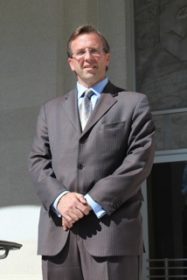
McGeorge Adjunct Professor Chris Micheli outside the California State Capitol

https://soundcloud.com/capimpactca/what-to-expect-at-the-end-of-session

The final weeks of the legislative session are the proverbial sprint to the finish line. Policy committees have finished the bulk of their work, but many bills get significant amendments that require the policy committees to hear additional bills as the session winds down. The main focus then becomes the fiscal committees and their

McGeorge Adjunct Professor Chris Micheli outside the California State Capitol

https://soundcloud.com/capimpactca/how-proxy-voting-could-work-in-the-california-assembly

The California State Assembly is poised to adopt a new rule to allow proxy voting. On July 27th, the first day back from its extended recess, Assembly Majority Floor Leader Ian Calderon introduced House Resolution 100 which would adopt a rule to allow proxy voting during the COVID‑19 state of emergency.

HR-100 notes that

McGeorge Adjunct Professor Chris Micheli outside the California State Capitol

https://soundcloud.com/capimpactca/remote-voting-in-the-california-senate

Since the California State Senate has authorized the use of remote voting, let’s take a look at how the process in the Senate works. Note, at this time, that the Assembly has not authorized remote voting yet.

First, remote voting is limited to only policy and fiscal committees. It is not currently authorized for

McGeorge Adjunct Professor Chris Micheli outside the California State Capitol

https://soundcloud.com/capimpactca/judicial-branch-support-agencies

California’s judicial branch is supported by several important entities that assist the judiciary in operating efficiently. These include the Commission on Judicial Appointments and the Commission on Judicial Performance. Let’s take a look at what they do, and who make up the memberships of these Commissions.

Commission on Judicial Appointments

The Commission on Judicial

McGeorge Adjunct Professor Chris Micheli outside the California State Capitol

https://soundcloud.com/capimpactca/how-to-use-californias-apa-to-your-advantage

The twin goals of the APA at the federal and state levels are to ensure for purposes of any proposed rulemaking that there’s notice to the public and an opportunity for the public to be heard. With that in mind, there are a few items of interest for those who participate in rulemaking activities

McGeorge Adjunct Professor Chris Micheli

https://soundcloud.com/capimpactca/urgency-clause-statutes

Urgency statutes are found in Article IV, Section 8 of the California Constitution. Bills signed into law by the Governor that contain an urgency clause become urgency statutes.

Article IV, Section 8(c)(3) of the Constitution lays out the major difference between a regular bill and an urgency bill. A regular statute goes into effect

McGeorge Adjunct Professor Chris Micheli

https://soundcloud.com/capimpactca/effective-versus-operative-dates-of-statutes

There’s often confusion in the California legislative process regarding effective versus operative dates. The most common effective date, basically the so-called default effective date, is January 1 following the year a bill was enacted.

As for operative dates, in 1956 the Attorney General declared that a statute may be worded to provide for an

McGeorge Adjunct Professor Chris Micheli

https://soundcloud.com/capimpactca/organization-and-structure-of-the-california-legislature

As one would imagine, the organization and structure of the California Legislature is found in Article IV, and there are half a dozen sections in Article IV that relate to the organization and structure of the Legislature. What are in these sections? I’ve included a sampling of some of the more comprehensive sections in

McGeorge Adjunct Professor Chris Micheli

https://soundcloud.com/capimpactca/nominations-and-commissions-by-the-governor

Provisions about nominations and commissions made by the Governor are found in California’s Government Code in Title 1, Division 4, Chapter 2, Article II. Article II deals with nominations by the Governor. Article III provides for commissions by the Governor.

Starting in Article II, with nominations, Government Code Section 1320 requires nominations that are

McGeorge Adjunct Professor Chris Micheli

https://soundcloud.com/capimpactca/rules-committees-in-the-california-legislature

The general business affairs of each house of the California Legislature are conducted by each house’s respective Committee on Rules. While the roles of the Senate and Assembly Committee on Rules are largely similar, they are different in several aspects.

As far as similarities are concerned, both committees:

  • Consider substantive legislation
  • Continue in existence