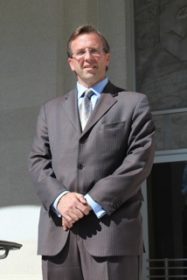
McGeorge Adjunct Professor Chris Micheli

https://soundcloud.com/capimpactca/overview-of-city-government-in-california

The over 475 cities in the state of California provide a wide range of municipal services including police, fire, parks, and libraries. A city’s government is headed by an elected or appointed Mayor to whom department heads are generally responsible. The City Council usually appoints a City Manager to oversee the city services.

Cities in California are either charter or general law cities. General law cities have their powers set forth in the California Government Code while charter cities have more powers. Their cities are governed by charters which can be changed by a vote of the electorate. Incorporated cities have the power of taxation and law enforcement, as well as zoning, parks, and other municipal services.

California cities are provided for in Article XI, Section 3 of the California State Constitution as well as the California Government Code. This also includes the process for the creation of city governments. Essentially cities in the state derive their authority from either the Government Code or from the electorate’s adoption of a city charter.

Pursuant to California law, there are three types of cities, again, general law cities, charter cities, and a consolidated city and county – which is in San Francisco. The general law cities, again, are governed by the Government Code. Charter cities, on the other hand, are governed by the adoption of their charters. The consolidated city and county is a city and a county that have been merged into one single jurisdiction. It’s governed by its own charter, and San Francisco is the only consolidated city and county in the state.

While counties are political subdivisions of the state, cities generally have greater authority than counties because they are voluntarily formed and they perform essential services which affect their citizens. Again, the California Constitution, in Article XI, and the Government Code, primarily in Section 34871, specify the differences between these general law and charter cities.

You can find a full transcript of today’s podcast here.

McGeorge Adjunct Professor Chris Micheli

https://soundcloud.com/capimpactca/sb-1343

Senate Bill 1343 was signed into law on September 30 as Chapter 956. It reduces the threshold requiring employers to provide employees with sexual harassment training from employers with 50 or more employees to employers with just 5 or more employees – including non-supervisorial, temporary, and seasonal employees.

The bill also requires the Department of Fair Employment and Housing to develop an online training course and make it available on the DFEH website. Existing law – the California Fair Employment and Housing Act – requires employers with 50 or more employees to provide at least 2 hours of proscribed training and education regarding sexual harassment, abusive conduct, and harassment based upon gender to all their supervisory employees within six months of their assuming that supervisory position and then once every two years thereafter.

SB 1343 instead requires an employer who employs five or more employees to provide at least two hours of sexual harassment training to all supervisory employees and then at least one hour of sexual harassment training to all non-supervisory employees by January 1, 2020 and once every two years thereafter.

The bill also requires DFEH to develop or obtain one-hour and two-hour online training courses on the prevention of sexual harassment in the workplace and to post these courses on the DFEH website.

DFEH is also required to make existing informational posters and fact sheets, as well as these online training courses, available to employers and to members of the public in specified alternative languages on the DFEH website. The languages include: English, Spanish, simplified Chinese, Tagalog, Vietnamese, Korean, and any other language that is spoken by a substantial number of non-English speaking individuals.

This required training can be provided with other training of employees. Employees can complete their training individually or as part of a group presentation. They can also complete the training in shorter segments as long as the total hourly requirement is reached. SB 1343 allows an employer to develop its own training module or direct employees to review the online training course that’s required by DFEH.

You can find a full transcript of today’s episode here.

McGeorge Adjunct Professor Chris Micheli

https://soundcloud.com/capimpactca/role-of-local-government-in-california

The role of local government cannot be overstated. The 58 counties, the 482 cities, and over 3000 special districts from transportation agencies to local air districts, water boards, and vector control agencies, all play a very critical role in making and implementing public policy throughout the state of California.

Counties are specified as “political subdivisions of the state” according to the California Constitution. Nonetheless, they’re very critical because they run so much of government that affects individuals in our society on an almost daily basis. For example, they provide health and human services funding, law enforcement, and they conduct elections at the local level. Local governments in California not only implement state laws but also they have rulemaking authority themselves. Some examples of a municipal ordinance could include regulating parking to even allowing or disallowing the sale of cannabis in their city or county.

State laws are certainly critical to our society, but local laws cannot be ignored. There are even local political laws such as those in major cities, such as Los Angeles and San Francisco or San Jose, that require everything from lobbyist disclosure and registration to local election laws that cap individual contributions to candidates even as low as $250. Regardless of whatever activities that you may be engaged in, you should not only be aware of the relevant state laws, but you also have to examine any local ordinances to ensure yours or your clients’ compliance with all of the laws that might impact your business or your conduct.

The 58 counties in California are governed by 5-member elected boards of supervisors – with the exception of San Francisco, which has an 11 member board because San Francisco is both a city and a county. Almost all supervisors are elected by district except in a few instances and they in turn generally utilize executives to manage the county functions. The main county executive is the CAO or the Chief Administrative Officer. Note that in all 58 counties, the district attorneys and the sheriffs are elected countywide independently of the Board of Supervisors.

There are more than 480 cities in California as well that provide a wide range of municipal services including police, fire, parks, libraries. Generally, the city government is headed by an elected or appointed mayor to whom department heads are then responsible. City councils usually appoint a city manager to oversee city services and staff. Note that incorporated cities have the power of taxation and law enforcement as well as powers such as zoning, providing for parks, recreational services and other municipal services.

The third type of local government is school districts. There are more than 1100 school districts in California that are generally overseen by an elected board of education and are governed independently from cities and counties.

The final type of local government is a special district. special districts in California are generally defined as, “Any agency of the state for the local performance of governmental or proprietary functions within limited boundaries” and the all provide specific services within a defined geographic area. There are approximately 3,000 plus special districts in California.

You can find a full transcript of today’s podcast here.

https://soundcloud.com/capimpactca/ab-3109

AB 3109 from the 2018 California legislative session concerns limiting certain types of contract waivers.

Governor Jerry Brown signed Assembly Bill 3109 by State Assemblymember Mark Stone on September 30. It is Chapter 959 and went into effect on January 1, 2019. This new law renders unenforceable any provision in a contract or settlement agreement that prevents a person from testifying in a judicial, administrative, or legislative proceeding in response to a court order, a subpoena, or an official request about alleged criminal conduct or sexual harassment.

During the 2018 legislative session, there were a number of bills that attempted to curb the use of secret settlements and address the issues of sexual harassment and discrimination, particularly in the workforce. According to the Senate Floor Analysis for AB 3109, this bill permits nondisclosure agreements so long as the parties are always able to speak as to the matters covered by the settlement if they are ordered or asked to do so in some official context – judicial, administrative, or legislative. The bill also adds Section1670.11 to the California Civil Code.

You can find a full transcript of today’s podcast here.

https://soundcloud.com/capimpactca/comparing-california-government-to-other-state-governments

Structurally speaking, California state government is not unique among the other states. All fifty states provide for a republican form of government in their individual constitutions. And all the states are based upon the federal government model with three branches of state government: the Legislative Branch, the Executive Branch, and the Judicial Branch. Let’s look quickly at all three branches.


Legislative Branch

With one exception, all states are bicameral and they all have upper and lower houses of differing sizes. For the lower houses, half a dozen states provide four year terms while the remaining states provide two year terms. The sizes of the houses range from forty two members to four hundred members.

For the upper houses, a dozen states provide two-year terms while the remaining states provide four year terms. And the sizes of these houses range from twenty one to sixty seven members. About thirty five states do not have terms limits for maximum service. Roughly twenty two states have a simple majority vote requirement for all their measures. The remaining states have a hybrid system requiring both simple and super-majority votes for measures that are considered.


The Executive Branch

The Governor is the chief executive in all fifty states, and in two states the length of a gubernatorial term is two years. In the remaining states it is a four-year term. Roughly sixteen states do not have a maximum limit on the number of terms that a governor can serve, while the remaining states cap the number of terms to two. About half a dozen states do not have a Lieutenant Governor, while the remaining states do.


The Judicial Branch

All of the states have the Supreme Court as the highest court in the state. Most states have seven seats on their high court, with the lowest at five and the highest at nine. Four states have lifetime appointments while the remainder use six to fourteen year terms with a majority at eight years. And roughly twenty states have a mandatory retirement age. About twenty states elect their high court justices, while the remaining states are appointed to their office.

You can find a full transcript of today’s podcast here.

https://soundcloud.com/capimpactca/sb-1155

Governor Jerry Brown signed Senate Bill 1155 by State Senator Ben Hueso on September 27 as Chapter 852. The bill revises the provision of law for language interpreters in small claims court. It also attempts to expand language access to limited English-proficient parties while in small claims court.

The Assembly repealed the section of law in order to ensure that parties in small claims actions are treated the same as parties in other civil actions for purposes of being provided interpreters. SB 1155 deletes the provisions that excludes small claims proceedings from the definition of a court proceeding for purposes of the requirement to use certified court interpreters and thereby extend that requirement to all small claims proceedings.

SB 1155 repealed Section 116.660 of the Code of Civil Procedure to strike the phrase “court proceeding.” In addition, the law requires each small claims court to make a reasonable effort to maintain and make available to the parties a list of interpreters who are able and willing to aid parties in small claims actions.

The new requirements and repeals language from the California Code of Civil Procedure went into effect on January 1, 2019.

You can find a full transcript of today’s podcast here.

This week’s episode of The CAP⋅impact Podcast features a meaty conversation about voting rights and elections with North Carolina Central University School of Law Professor Irving Joyner – who in addition to teaching is Legal Counsel for the North Carolina NAACP. In a conversation that covers gerrymandering, and lawsuits against voter ID laws, and election fraud I did not expect that a history lesson would be the part of the conversation would be most interesting and impactful thing we talked about.

But today’s conversation I think is truly about the importance of history and how it still influences voting rights in the present. North Carolina’s new voter ID law is a prime example of how. One of the requirements to obtain a driver’s license is to have a birth certificate. That might not be an issue for most folks, but for thousands of African Americans in North Carolina who born during the Jim Crow era, it is. That’s because Jim Crow laws prevented African Americans from giving birth in hospitals and which in turn prevented them from getting birth certificates. So, should this new voter ID law go into effect in North Carolina, thousands of African Americans will lose their voting rights because they had the misfortune of being born in the Jim Crow south.

That voter ID law is one example of Prof. Joyner’s ongoing work to protect voting rights. He was also involved in the process that led to a new election in North Carolina’s 9th Congressional District after an investigation confirmed election fraud occurred and has been involved in multiple lawsuits against gerrymandered state legislative and congressional district maps in North Carolina.

You can learn more about Professor Irving Joyner on his NCCU School of Law faculty page and you can find his published work here. As always, if you enjoyed today’s conversation please share it with a friend. Or, if you haven’t already, please subscribe to The CAP⋅impact Podcast on your preferred podcast listening app and leave us a positive review and 5-star rating on Apple Podcasts.

https://soundcloud.com/capimpactca/episode-45-the-ongoing-fight-for-voting-rights-with-prof-irving-joyner/s-Ws1fn


https://soundcloud.com/capimpactca/california-research-bureau

The California Research Bureau is a part of the California State Library and it’s a hidden gem located on the fifth floor of the California State Capitol Annex. It has been around for over a quarter of a century and it provides independent research and analysis to the Legislature and the nine constitutional officers.

The Bureau, or CRB, has more than a dozen individuals on its research staff who explore issues, provide policy research, multi-state reviews, academic and media summaries, data analysis, fact checking, and much more. In addition, they provide weekly updates that are quite helpful.

The first is called Lunch with a Side of Research. It’s a free weekly email that lists all upcoming events in Sacramento that include both a free lunch and a public policy research discussion. It comes out every Monday morning at 8 am.

Studies in the News is a weekly roundup of high quality research and surveys on policy issues relevant to the state of California. The Research Bureau releases each new issue Wednesdays at 8 am.

The CRB also provides services that include fact finding and fact checking; review and assessment of third party data or research; analysis of data from other levels of government; media and news collection of various topics; summaries of scholarly research; investigative surveys; 50-state reviews; tracing of bills, regulations, and court decisions; in depth research; and other specific public policy topics requested by legislators or constitutional officers.

For the elected legislators and staff and the constitutional officers the Bureau can greatly assist in researching and analyzing public policy issues and measures that are being debated, and they can provide additional data to assist decision makers in their deliberations.

You can find a full transcript of today’s brief podcast here.

https://soundcloud.com/capimpactca/sb-224

Senate Bill 224 deals with sexual harassment. Governor Brown signed SB 224 by State Senator Hannah-Beth Jackson on September 30, as Chapter 951. The bill adds investors, elected officials, lobbyists, directors, and producers to the list of examples of relationships that are covered by Civil Code Section 51.9. Civil Code Section 51.9 imposes civil liability for sexual harassment in the business, service or professional context.

According to the analysis of this bill, because the current list of examples is not exclusive, it deems this bill as declaratory of existing law. Nonetheless, it serves to highlight that investors, elected officials, lobbyists, directors, and producers can be subject to liability if they engage in sexual harassment.

Existing law establishes liability for sexual harassment when the plaintiff proves certain specified elements; among other things, that there’s a business, service, or professional relationship between the plaintiff and the defendant, and that there’s an inability for the plaintiff to easily terminate that relationship.

Existing law also states that a relationship may exist between a plaintiff and certain persons, including – under the law prior to SB 224 – attorneys, holders of a master’s degree in social work, real estate agents, and real estate appraisers. Senate Bill 224 not only amended Civil Code Section 51.9, but it also amended sections 12930 and 12948 of the Government Code so that it includes within the elements in a Cause of Action for sexual harassment, when the plaintiff proves that the defendant holds himself or herself out as being able to help the plaintiff to establish a business, service or professional relationship with either the defendant or a third party.

To summarize, SB 224 eliminates the element that the plaintiff proves that there’s an inability by the plaintiff to easily terminate the relationship. Next, the bill includes an investor, elected official, lobbyist, director, and producer among those listed persons who may be liable to a plaintiff for sexual harassment. Third, the bill makes the Department of Fair Employment and Housing responsible for the enforcement of sexual harassment claims. Finally, the bill makes it an unlawful practice to deny or aid, incite or conspire in the denial of rights of persons related to sexual harassment actions.


https://soundcloud.com/capimpactca/californias-role-in-national-politics

The state of California has long played a relatively outsize role in national politics for a number of reasons. An often mentioned phrase in national politics is, “What starts in California often migrates to the rest of the country.” As such, how public policy issues are addressed here in the state of California – by legislation, by regulation, or by judicial decision – often sets the standard for other states and even the nation as a whole.

Many state capitol observers note that California legislators enjoy being the first in the nation with some of their bills. In the past, California legislators have often considered what’s been enacted in some of the other states, particularly those who might be deemed comparable, at least in relative terms of size, such as New York, Pennsylvania, Florida, Texas, Illinois, etc. But, in recent years, it seems that’s less of a consideration and now being at the head of the pack, if you will, of the different states often seems to be the preferred route.

What are some of the reasons that California plays such a prominent role in national politics? Well the obvious ones include the fact that California is the largest state in the nation by population size. If it were a country, it would be the fifth largest economy in the world today. And certainly, Californians and their elected officials view themselves as leaders, not as followers.

What are some of the policy areas that California has tried to be the leading role model in national politics? Well certainly climate change comes to mind, with California leading efforts nationally, and frankly even internationally, to deal with the problems of climate change. And while the Trump administration generally hasn’t even agreed that such a problem exists, there’s been quite a lot of disagreement and quite a bit of legislation and even lawsuits regarding climate change.

California has also played a significant role in national politics through litigation in recent years. Attorney General Becerra in the state has filed more than forty lawsuits that have challenged federal actions, including lawsuits on immigration laws, the US Census, education, student debt, net neutrality, provisions of healthcare, and many in the environmental and climate change arenas. It’s interesting that during the 2017-18 state fiscal year, the AG incurred about $9 million in legal bills on a lot of these measures which was up over $6 million from just the prior fiscal year. So quite a considerable amount.

Finally, and probably most importantly, California has played a major role in national politics. Although, to be fair, most of our influence has come in the form of campaign contributions. We, despite even moving up our primary during a presidential election year, still have not as a state been able to really impact the presidential election.

Nonetheless, we do impact the federal elections because we do have the most Electoral College votes for purposes of the Presidential election. And of course we have the largest Congressional delegation.

You can find the full transcript of today’s podcast here.