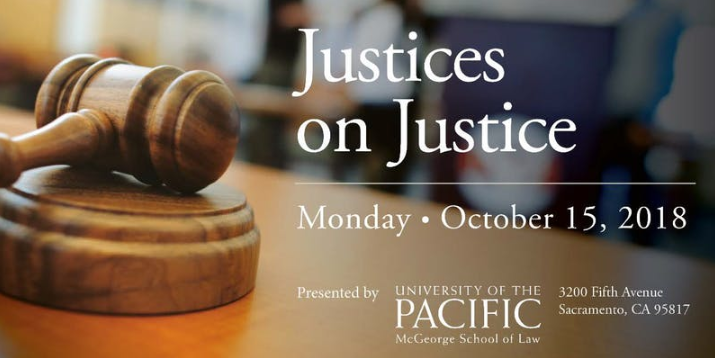
We want to you to be a part next week’s event – Justices on Justice. Please join the University of the Pacific, McGeorge School of Law community at this event to celebrate the newly created Justice Anthony M. Kennedy Endowed Chair, made possible by a $1 million gift from the Tsakopoulos Family Foundation, which was doubled by the university’s Powell Fund match to create a $2 million endowment. Angelo K. and Sofia Tsakopoulos are longtime friends of Anthony and Mary Kennedy and the McGeorge School of Law. Kyriakos Tsakopoulos is a 1997 McGeorge alumnus. The Endowed Chair will provide the resources to bring prominent faculty to McGeorge to teach and advance legal thinking through scholarship and leadership in the legal community.

The event is a panel discussion moderated by McGeorge School of Law Professor, Constitutional Law expert, and Capital Center Director Leslie Gielow Jacobs. The panelists are Associate Justice of the United States Supreme Court Anthony Kennedy (retired), Presiding Judge of the Constitutional Court Chamber at the Kosovo Specialist Chambers in The Hague Ann Power-Forde, Justice of the California Supreme Court Joseph Grodin, and Judge in the Constitutional Court of the Republic of Austria Dr. Wolfgang Brandstetter.

While this event is SOLD OUT, you will be able to catch a livestream of it here.


Recapping Governor Brown’s Bill Actions in 2018 (transcript)

https://soundcloud.com/capimpactca/recapping-governor-browns-bill-actions-in-2018

Today’s post is a summary of the bill actions by Governor Jerry Brown in 2018, his last year in office.

While the 2018 legislative session concludes sine die on November 30th, for all practical purposes the session ended on September 30, which represented the last day by the constitution for Governor Brown to act on all the bills sent to his desk in those final weeks of the legislative session.

He actually acted on bills every month of the year – from January with just one bill through September where he acted on 941 bills. So there were well over 1,000 bills that reached his desk. The exact number? 1,217 of those bills.

Now, this year, the 2018 session that began in early January and concluded by the constitution on August 31 dealt with 2,225 bills were introduced between the two houses of the Legislature. The Senate introduced 694 bills in 2018. The Assembly introduced 1,531 bills.

Of those 1,217 that made it down, 55% of the bills introduced made it to the Governor’s desk and 45% of the bills introduced – again that 2,225 number – got signed into law while a mere 9% of the bills that were introduced got vetoed. Of course, of the 1,217 bills a certain number were signed and vetoed.

The Governor this year vetoed 201 bills, which represents 16.5% – the highest he’s ever done. Let’s look a little closer at those bills the Governor signed and vetoed this year. Again, the magical number was 1,217.

I go into a greater detailed breakdown of the bills signed and vetoed by Governor Brown in today’s podcast.

Here’s our rundown of the news we’ve been reading and thinking about this week. While we try to seek out stories that aren’t the main story line of the week, sometimes the big story is just unavoidable.


CNBC

Elon Musk mocks SEC as ‘Shortseller Enrichment Commission’ days after settling fraud charges by Sara Salinas and Christine Wang

Jon’s take: Maybe it’s a good thing that Elon Musk is being forced to step from Chairman of the Board at Tesla. In terms of creativity and thinking about ways to approach major societal problems, I still think he’s a genius. That said, between his 420 tweet that got him and Tesla into this mess originally and now another tweet mocking the SEC after settling with them – both of which had a negative impact on Tesla stock – I’m inclined to think that he maybe shouldn’t be running the day-to-day of the company.


NBC News

Some undecided GOP senators on Kavanaugh call FBI report ‘reassuring’ and ‘thorough’ by Rebecca Shabad and Frank Thorp V

Molly’s take: A week long investigation is thorough according to key GOP senators on the confirmation vote for Judge Kavanaugh. Today, of course, Kavanaugh passed a symbolic hurdle and was moved forward to the next step of being the next Supreme Court Justice when the U.S. Senate voted to end debate on his nomination. As someone who has watched the hearings closely, Kavanaugh’s professionalism is concerning. Do we want someone so swayed by politics as the next “independent” judge on the highest court in the United States? 51 Senators said yes.

Whether or not Kavanaugh is confirmed, this is an important and eye opening experience. Watching Senators push through a rushed investigation to confirm a man accused of a heinous act is disheartening to say the least. More so, do I feel like we should look at the ABA’s Rules of Judicial Conduct… does he meet those standards?

Now, I feel as if I can only watch as he gets closer and closer to the highest bench, and politicians who led the outcry for a thorough investigation of Clinton’s emails, step back and call a week long investigation sufficient.

Laura Curtis, who just finished her first year as a lobbyist, sits down with McGeorge alum and adjunct professor Chris Micheli, to talk about her experience as a lobbyist and being a part of the advocacy at the California Chamber of Commerce.

https://soundcloud.com/capimpactca/episode-24-lobbying-year-one-reflections

You can also check out last week’s episode where Laura talks about her recent career switch – from working in a legal career in the San Francisco Bay Area to lobbying for the California Chamber of Commerce in California’s capital. The two talk about her experience switching careers and the biggest differences between being a practicing attorney and a lobbyist.

As always, if you enjoyed today’s episode, please take the time to leave us a five-star rating on iTunes, Apple Podcasts, or Stitcher Radio, and subscribe to our show wherever you listen to podcasts. All of that makes The CAP⋅impact Podcast easier to find and more accessible.

You can also stay in touch with us and let us know what you thought about today’s show and think about the show generally on Facebook and Twitter. Just like CAP⋅impact on Facebook or follow @CAPimpactCA on Twitter.

The CAP⋅impact Podcast is made possible by the Capital Center for Law & Policy at McGeorge School of Law in Sacramento, California. You can learn more about the Capital Center here, and keep up with the Capital Center on Facebook and Twitter.

The deadline for Governor Jerry Brown to sign or veto bills has come and passed so there are now no more bills in legislative limbo. This is the final rundown of how the bills we looked at this year fared.

Assembly Bills

  • AB 186: Controlled substances: overdose prevention program – Vetoed
  • AB 638: Immigration consultants – Dead, died on the Senate floor (13 Ayes, 17 Noes)
  • AB 931: Use of force by peace officers – Dead, held in Senate Rules Committee.
  • AB 1436: Suicide prevention training – Signed into law
  • AB 1784: Pilot program for support services for resource families – Dead, held on Suspense file in Senate Appropriations. Will be revived next session.
  • AB 1971: Reform of the Lanterman-Petris-Short Act – Dead, ordered to inactive file by coauthor
  • AB 2018: Loan forgiveness program for public mental health professionals – Dead, held on Suspense File in Senate Appropriations
  • AB 2551: Forestry and fire prevention – Signed into law
  • AB 2780: Family Law: support orders – Signed into law

Senate Bills

  • SB 320: Medication abortion at public universities – Vetoed
  • SB 822: Net Neutrality – Signed into law
  • SB 901: Wildfires – Signed into law
  • SB 906: Mental health service, peer support specialist certification – Vetoed.
  • SB 923: Criminal investigations: eyewitness identification – Signed into law
  • SB 1004: Mental Health Services Act: prevention and early intervention – Signed into law
  • SB 1113: Mental health in the workplace: voluntary standards – Signed into law by Governor Brown
  • SB 1421: Public access to police records – Signed into law

So, now that the Governor has finished acting on legislation that makes the final count 4 bills dead in the Legislature, 9 bills signed into law by Governor Jerry Brown, and 2 vetoed bills.

By: Reymond Huang

Divorcing couples often face emotional and financial challenges. Emotions of anger and confusion flood divorce proceedings, creating an uncomfortable atmosphere. Furthermore, the parties must inevitably adjust to a new standard of living. Typically, one party is the breadwinner while the other stayed at home and took care of the children. Divorce overturns these roles. The stay at home parent may find a job to support the family while the breadwinner may work less to spend more time with the children.

Eventually, the parties must determine spousal and child support. Each side will jostle for less or more monetary support. Oftentimes parties will purposefully reduce their income or refuse to work. The objective: to pay less or receive more spousal or child support. Vocational evaluators help solve this problem. A vocational evaluator evaluates how much a party can earn given that party’s education, work experience, and other factors. A judge places great weight on a vocational evaluator’s determination and will assign income on a party based on the vocational evaluator’s report.

Assembly Member Richard Bloom (D – Santa Monica) introduced AB 2780 because vocational evaluators are “underutilized tools in family law cases.” AB 2780 “seeks to increase access to vocational evaluators” by expanding the educational requirements of vocational evaluators. Current state law provides that vocational evaluators must hold a master’s degree in the behavioral sciences. Under AB 2780, a vocational evaluator may possess a master’s degree in the behavioral sciences or any other postgraduate degree that a court will find sufficient to conduct an evaluation. In addition, AB 2780 allows a court to consider the overall welfare and developmental needs of the child along with the amount of time a parent spends with the child in determining the parent’s earning capabilities. AB 2780 included the language ‘the overall welfare and developmental needs of child and the time the parent spends with the children’ into Family Code Section 4058(b).

The Family Law Executive Committee of the California Lawyers Association sponsored AB 2780 and the California Protective Parents Association supported this bill as well. AB 2780 did not face any opposition.

However, A.B. 2780’s goal may be stymied by practical hurdles. Divorce is expensive, and parties may completely avoid hiring attorneys or experts. Courts supply ample resources for parties to conduct the divorce on their own. In addition, mediation provides a popular alternative to hiring attorneys for divorces. Furthermore, A.B. 2780 does not define the scope of educational degrees that may qualify a vocational evaluator. Finally, A.B. 2780 re-states many principles that have already been determined by courts such as the time a parent spends with his or her child and the developmental needs of the child.

Governor Brown approved AB 2780 on August 20, 2018 and became Chapter 178.

To learn more about AB 2780, listen to my interview coming soon on “In Session,” a podcast from the University of the Pacific Law Review.

Reymond Huang is a staff writer for the University of the Pacific Law Review and law student student at McGeorge School of Law in Sacramento.

Over the weekend, Governor Jerry Brown signed SB 826 into law. The legislation, authored by Senator Hannah-Beth Jackson, requires publicly traded companies to include women on its boards of directors.

Professor Jacobs’ comments on the legal concerns about the bill from the report are below. You can find the full report by KCRA’s Marlei Martinez with the five things you need to know about the legislation here.

Equal protection issues

“That’s the problem here. It mentions sex explicitly, and so it would be a high bar for the state to be able to argue that it’s okay to favor women over men.”

Interstate commerce issues

“What’s going on with this law is that it applies to corporations that have a principal place of business here, even if they’re incorporated in another state.”


Standing Committees and Their Jurisdictions (transcript)

This post is on legislative committees and their jurisdictions.

https://soundcloud.com/capimpactca/standing-committees-and-their-jurisdictions

Both houses of the California legislature provide committees of legislators to do their work based upon subject matter jurisdiction.

With fewer legislators, the Senate naturally has a fewer number of committees than the State Assembly. Nonetheless, both consider legislation from their house of origin as well as the other house.

This is a brief overview of the Senate and Assembly standing committees and their basic jurisdictions. In the Senate, there are 21 standing committees that are provided pursuant to Rule 12 of the Standing Rules of the Senate. Let’s turn to the Assembly and its committees. There are 32 standing committees in the Assembly, pursuant to Rule 11 of the Standing Rules of the Assembly.

I go into greater detail about the committees and their jurisdictions in today’s audio. Thanks for listening.

Capital Center for Law & Policy Director Leslie Gielow Jacobs and McGeorge Professor Clark Kelso were both recently interviewed by KCRA 3’s Vicki Gonzalez about the recent U.S. Senate Judiciary Committee hearing with testimony from Dr. Christine Blasey Ford and Supreme Court nominee Judge Brett Kavanaugh. Quotes from Professors Jacobs and Kelso are below. You can find the full report and video from KCRA here.

Professor Leslie Gielow Jacobs

“In a trial, this wouldn’t be appropriate. We’d have a jury that might be sequestered so they wouldn’t hear outside evidence. Here, it’s appropriate that all the voters hear this evidence and make a judgement about it, so that the Senators can take that into account.”

Professor Clark Kelso

“There are so many details that could be followed up on if there were to be a proper, relatively quick investigation. There are a lot of people who the FBI could talk to. There are details that could be further explored.”

“It comes down to a question of ‘Do they have 51 votes?'”

If we’re being completely honest, the only story any of us were really following this week was the Senate Judiciary Committee hearing for Dr. Christine Blasey Ford and Judge Brett Kavanaugh, and today’s news that a new FBI probe of Kavanaugh has been ordered.

There were, however a few other interesting stories that were buried this week that Jon Wainwright tracked down.


New York Times

Tesla Chief ELon Musk is Sued by S.E.C. in Move That Could Oust Him by Matthew Goldstein and Emily Flitter

Jon’s take: It really has not been a good run for Elon Musk lately. First he angered shareholders by smoking marijuana on camera while recording a podcast with Joe Rogan. Now his tweet from last month is coming back to haunt him.

I’m trying to process why he would do something so stupid, just to amuse his girlfriend, and now potentially be on the receiving end of the harshest penalty the S.E.C. can render. Talk about harshing the vibe, man.

Sacramento Bee

‘We have enough mischief:’ Jerry Brown vetoes later bar closing times. by Andrew Sheeler

Jon’s take: I’m going to miss Governor Brown, and I’m especially going to miss his veto messages.